
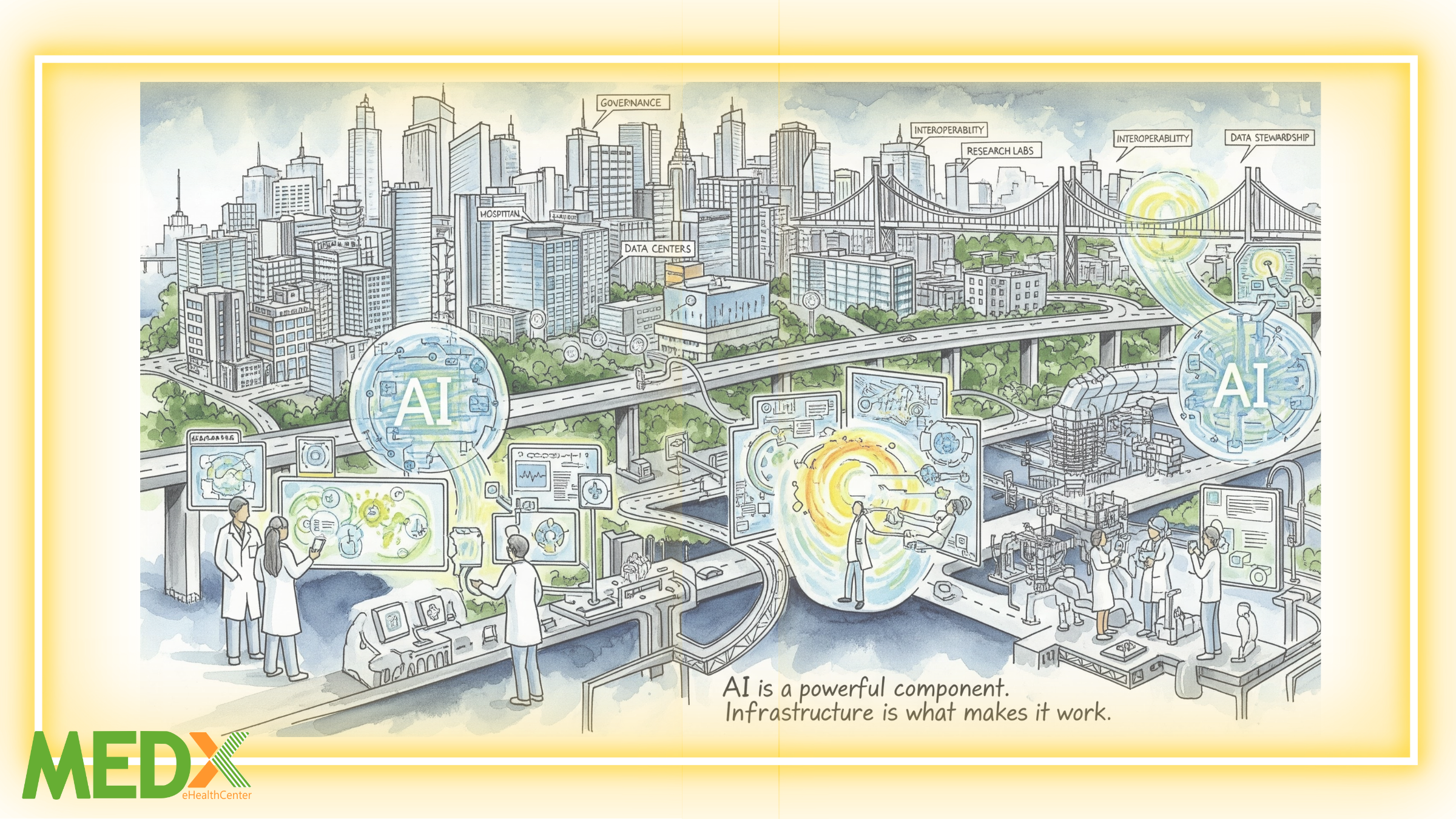
AI Is Not Health Infrastructure — But It Is About to Depend on It
The emergence of advanced AI systems in healthcare, including the introduction of ChatGPT Health, marks a significant moment for global health systems. These technologies promise to support clinicians, improve access to information, streamline workflows, and enhance patient engagement at unprecedented scale.
This progress is welcome.
But it also brings clarity.
AI, no matter how capable, does not constitute a health system. It does not replace governance, financing, accountability, or institutional stewardship. Instead, it depends on them.
From Capability to Consequence
Tools like ChatGPT Health are designed to assist—providing intelligence, guidance, and support across clinical and administrative contexts. Yet their real-world impact will be determined not by their sophistication, but by the systems into which they are deployed.
Without clear data governance, interoperability standards, regulatory alignment, and defined custodianship, even the most advanced AI risks becoming:
Underutilized
Misaligned with national priorities
Inconsistent across providers
Or excluded from public-sector adoption altogether
History has shown that innovation alone does not translate into impact. Systems do.
The Institutional Challenge Ahead
For governments, ministries of health, and public healthcare institutions, the question is no longer whether to adopt AI in healthcare—but how to do so responsibly, equitably, and at national scale.
This requires answers to difficult questions:
Who governs AI-enabled health systems?
How is data sovereignty protected?
How do AI tools integrate with existing national platforms?
How are accountability and safety ensured over time?
How do we avoid fragmentation between pilots, vendors, and regions?
These are not software questions.
They are infrastructure questions.
MEDx’s Role: Making AI Implementable at System Level
This is where MEDx eHealthCenter positions itself.
MEDx does not build AI platforms.
Instead, we design, deploy, and steward the digital health infrastructure that allows AI to be implemented effectively within public systems.
Our role is to help institutions:
Prepare their digital foundations for AI adoption
Align AI deployment with national health strategies and regulations
Integrate tools like ChatGPT Health into interoperable, governed ecosystems
Ensure long-term accountability beyond pilot phases
Translate AI capability into sustained public value
In this sense, AI is not the destination—it is a component within a larger system.
Accelerating Adoption Without Losing Control
As AI becomes embedded in healthcare, institutions will need trusted partners who can:
Bridge innovation and governance
Align global tools with local realities
Protect public trust while enabling progress
MEDx exists precisely at this intersection.
By treating primary healthcare digitalization as infrastructure, we enable governments and healthcare systems to adopt AI faster—not by bypassing governance, but by strengthening it.
A Shared Future
The arrival of ChatGPT Health signals a new phase in digital health—one defined by intelligence at scale. Its success, however, will depend on the maturity of the systems that surround it.
AI will transform healthcare.
But infrastructure will determine who benefits, how sustainably, and for how long.
MEDx is committed to ensuring that this transformation is:
System-led
Institutionally grounded
Equitable by design
And trusted by the societies it serves
In the years ahead, the most successful health systems will not be those with the most advanced tools—but those with the strongest foundations.