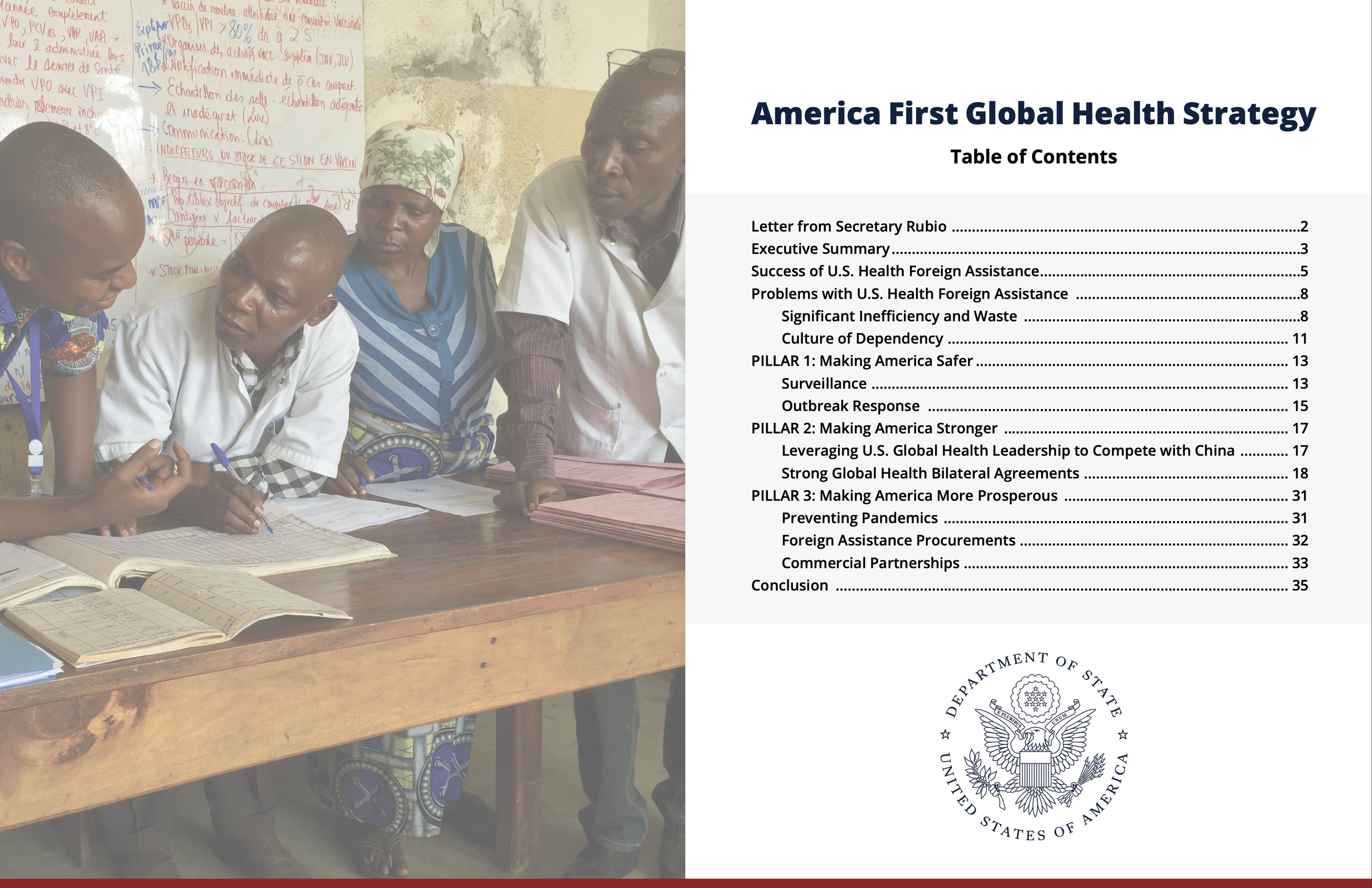
American First Global Health:
From Multilateral Architecture to Sovereign Security
Over the past two decades, global health cooperation has largely been defined by multilateral institutions, pooled funding mechanisms, and cross-border technical partnerships. The United States has historically played a central role in shaping this ecosystem—through support to organizations such as the Global Fund, UNAIDS, WHO, and multilateral health security frameworks.
In 2025, however, a significant strategic shift became visible.
The consolidation of global health under the Bureau of Global Health Security and Diplomacy (GHSD) reflects a reframing of health not primarily as a development issue, but as a matter of national security and sovereign interest. Under an “America First” orientation, global health policy has moved toward a model that emphasizes direct U.S. diplomatic engagement, bilateral coordination, and national control over priority-setting and implementation pathways.
This transition marks a deeper evolution in how global health is conceptualized.
From Multilateral Expansion to Security Consolidation
Historically, global health cooperation operated through multilateral expansion. Programs were built through international coalitions, pooled financing instruments, and collaborative governance structures. The underlying premise was interdependence: that infectious diseases, HIV/AIDS, pandemics, and health system weaknesses transcend borders and therefore require coordinated global responses.
The new approach does not reject global engagement—but it restructures it.
Under the GHSD model, global health security is integrated into U.S. foreign policy and national security architecture. Diplomatic engagement, outbreak response coordination, and support to U.S. missions overseas become central operational pillars. Rather than broad multilateral ecosystem-building, the focus shifts toward:
Monitoring and responding to infectious disease outbreaks
Strengthening foreign government capacity in targeted countries
Expanding research and development for medical countermeasures
Promoting bilateral diplomatic coordination
Elevating health security within national security policy
This is a narrower, more controlled architecture.
What Is Being Reduced — and What Is Being Reinforced
The shift does not eliminate global health engagement, but it changes its structure.
Programs heavily dependent on multilateral governance platforms, cross-border digital integration initiatives, or large-scale system modernization efforts may see reduced prioritization.
In contrast, the following areas are reinforced:
Infectious disease surveillance
Outbreak preparedness and response
Medical countermeasure development and distribution
One Health integration (human, animal, environmental nexus)
Diplomatic health security capacity
The emphasis moves from “system-wide transformation” to “security-aligned capacity strengthening.”
A Sovereign Turn in Global Health
The underlying strategic logic reflects a broader geopolitical reality: sovereign resilience.
In a world increasingly defined by geopolitical competition, supply chain fragility, and shifting alliances, health is no longer treated solely as humanitarian engagement. It is viewed as a component of national resilience and global stability.
Under this model:
National capacity takes precedence over pooled governance
Bilateral influence may outweigh multilateral coordination
Strategic countries receive focused engagement
Funding mechanisms are more tightly aligned with security objectives
This approach may lead to more disciplined prioritization. It may also reduce reliance on global institutions that historically shaped collective health policy.
Implications for Global Health Architecture
The most important implication is architectural.
Global health is no longer governed by a single organizing logic. Two models are emerging:
Security-Centered Health Strategy
Focused on outbreak prevention, surveillance, countermeasures, and sovereign capacity.Infrastructure-Centered Health Strategy
Focused on digital public infrastructure, system interoperability, primary care modernization, and long-term governance reform.
These models are not mutually exclusive. But they operate at different layers.
Health security requires strong infrastructure to function effectively. Surveillance data must move across interoperable systems. Countermeasure distribution depends on digital logistics. Governance frameworks determine sustainability.
Where security frameworks concentrate on acute threats, infrastructure frameworks concentrate on structural resilience.
A Fragmented but Strategic Future
The “America First” global health strategy signals that the era of broad, diffuse, multilateral program expansion is evolving. In its place, a more strategic, security-aligned, and diplomatically integrated architecture is emerging.
For institutions, governments, and organizations operating in global health, this shift requires clarity:
Where does your work sit — at the security layer or the infrastructure layer?
How does your model adapt to bilateral engagement structures?
Can your systems support health security objectives without being solely defined by them?
Global health is entering a period of recalibration.
The core lesson is not that cooperation is ending. It is that cooperation is being restructured.
In this new landscape, resilience will depend not only on responding to crises—but on building systems strong enough to withstand them.